Homeowner Resource Guide
Retaining Wall Questions, Answered
Whether you're worried about a leaning wall, comparing estimates, dealing with erosion, or planning a better backyard, you'll find straightforward answers here. Learn what to look for, what questions to ask, and what to consider before moving forward.
Serving homeowners in Cartersville, Bartow County, and surrounding North Georgia communities.
Retaining Wall Costs, Estimates & Hiring
Understand what affects pricing, how to compare estimates, and what to ask before committing to a project.
How much does a retaining wall cost in Cartersville, GA?
Retaining wall costs vary considerably because no two sites are exactly alike. The biggest factors usually include wall length and height, materials, soil conditions, drainage, excavation, and access for equipment. A short landscaping wall is a very different project from a structural wall supporting a driveway or steep hillside.
Demolition, engineering, permits, hauling, and landscape restoration can also affect the total. Rather than relying on a broad online price range, ask for an estimate based on your property's actual conditions and the work involved.
Why are some retaining wall estimates so much more expensive than others?
Two contractors may be proposing very different solutions. One estimate might include excavation, a properly prepared base, drainage materials, reinforcement, and restoration. Another may cover only the visible wall.
Site access, disposal costs, engineering, and material choices can also make a significant difference. Compare what each proposal includes, not just the final price. If one estimate is dramatically lower, ask what is different about the design or scope.
Is it cheaper to repair a retaining wall or replace it?
A limited repair may cost less if the damage is localized and the wall remains structurally sound. But repairing the surface of a wall that is leaning, bulging, or shifting may only postpone a larger problem.
The cause matters more than the appearance. If poor drainage, inadequate support, or foundation movement caused the failure, those conditions need to be addressed. In some cases, replacement is the more practical long-term choice.
What should a retaining wall estimate include?
A useful written estimate should identify the wall's location, approximate dimensions, materials, site preparation, base construction, and drainage approach.
Ask whether excavation, demolition, removal of the old wall, disposal, backfill, reinforcement, engineering, permits, grading, and landscape restoration are included. It should also explain what work is excluded and how unexpected site conditions will be handled.
How do I compare retaining wall contractors?
Start by comparing their proposed approach to your actual problem. Ask how the wall will handle soil pressure, water, and any loads above it. Request a written scope and ask who will perform the work.
Check applicable credentials, insurance, references, and experience with similar projects. Be cautious of anyone who dismisses obvious structural or drainage concerns, pressures you to decide immediately, or requests full payment before work begins.
A good estimate should help you understand what you're buying.
Should I get more than one retaining wall estimate?
For a substantial project, comparing multiple written estimates is a sensible precaution. It can help you understand different construction approaches and identify missing items.
Try to compare similar scopes. A proposal that includes engineering, drainage, excavation, and reinforcement should not be treated as equivalent to one that simply lists blocks and labor.
If the wall is visibly unstable, prioritize safety and a qualified evaluation rather than waiting for a routine bidding process.
Retaining Wall Damage, Repairs & Safety
Learn what common warning signs may mean and when a retaining wall deserves prompt attention.
How can I tell if my retaining wall is failing?
Warning signs include increasing lean, outward bulging, widening cracks, separated blocks, loose stones, sinking ground above the wall, and soil washing out through openings.
A little weathering is not the same as structural movement. The most concerning signs are changes that continue or become worse, especially after heavy rain.
If you notice significant movement, keep people away from the affected area and arrange for a qualified evaluation.
Is a leaning retaining wall dangerous?
It can be. A leaning wall may be experiencing excessive soil or water pressure, foundation movement, or inadequate support. The risk depends on the wall's height, condition, design, and what it supports.
A tall wall beside a driveway, home, sidewalk, or frequently used area deserves particular attention. Do not attempt to push the wall back into place or remove supporting material without professional guidance.
If collapse appears possible, keep people and vehicles away.
Can a cracked retaining wall be repaired?
Sometimes. Minor surface cracks or isolated damaged components may be repairable, depending on the wall system.
However, widening cracks, horizontal cracks, bulging, separation, or movement can indicate problems beyond the surface. Filling a crack will not correct excessive pressure or foundation instability.
The appropriate repair depends on identifying why the cracking occurred.
Why do retaining walls collapse?
Retaining walls can fail because of water pressure, poor drainage, inadequate base preparation, foundation movement, unsuitable backfill, insufficient reinforcement, or loads greater than the wall was designed to support.
Heavy rain, erosion, changes to nearby grading, or new loads above a wall can contribute to an existing weakness.
A replacement should address the underlying conditions rather than simply reproduce the failed structure.
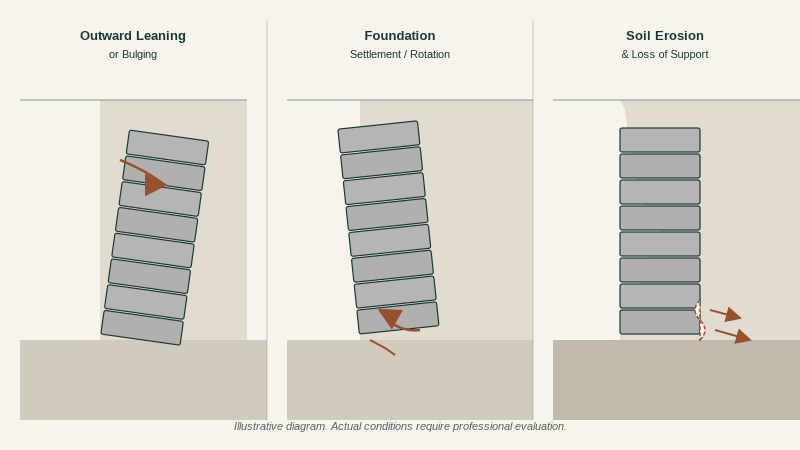
Illustrative diagram. Actual conditions require professional evaluation.
Can I straighten a retaining wall that's already leaning?
That depends on the wall type and the cause and extent of movement. Some systems may have specialized repair options, but a significantly displaced wall often requires partial or complete reconstruction.
Trying to pull or push an unstable wall back into position can be hazardous. It may also leave the original drainage or foundation problem unresolved.
Have the wall evaluated before attempting a repair.
What should I do if my retaining wall collapses?
Keep people and pets away from the wall and the surrounding soil. A partial collapse can leave adjacent sections unstable.
Avoid walking on the slope above the failed area, parking nearby, or attempting to remove large blocks yourself. If a driveway, building, utility, or public walkway is threatened, contact the appropriate emergency or utility authority.
Document the damage from a safe location and arrange for a qualified assessment before cleanup or reconstruction.
What retaining wall maintenance should I perform after heavy rainfall?
After a major storm, visually inspect your retaining wall from a safe location.
Look for new cracks, increasing lean, bulging, separated blocks, soil washing out, erosion near the base, and changes in the ground above the wall.
Check accessible drainage outlets for obvious debris or blockages without dismantling any part of the system. Also look for runoff patterns that may be directing additional water toward the wall.
Do not climb on, excavate around, or attempt to straighten a wall that appears unstable.
If you notice new movement, significant erosion, or other signs of structural distress, keep people away and arrange for a qualified evaluation.
Drainage, Erosion & Sloped Properties
Understand how water and soil movement affect retaining walls and what other improvements may be worth considering.
Does every retaining wall need drainage?
Drainage is an important consideration in retaining wall design. Water that accumulates behind a wall can increase pressure and contribute to movement or failure.
Depending on the wall system and site conditions, drainage may involve gravel backfill, collection pipes, outlets, surface grading, or other measures.
There is no single drainage detail suitable for every wall. The appropriate solution depends on the site and the wall's design.
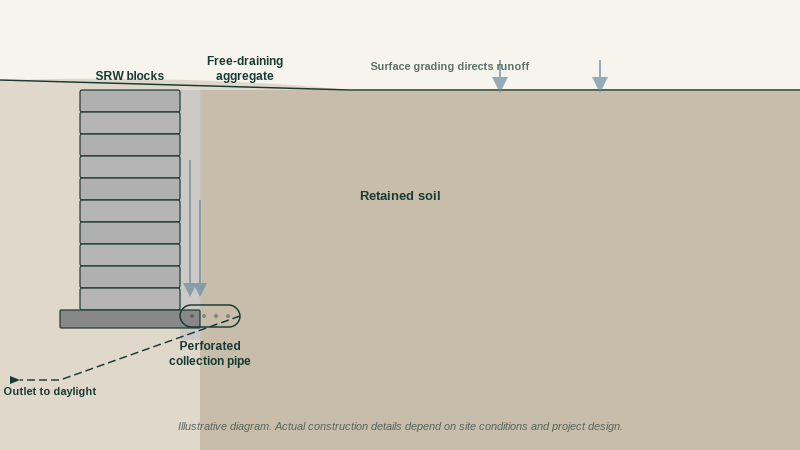
Illustrative diagram. Actual construction details depend on site conditions and project design.
Why is water coming through my retaining wall?
Some wall systems are designed to allow collected water to escape through designated outlets or openings. However, unexpected water flow, persistent saturation, muddy discharge, or soil washing through joints may indicate a drainage or erosion problem.
Notice when the water appears, where it exits, and whether soil is moving with it.
Avoid sealing drainage openings without understanding their purpose. Trapping water behind the wall can make conditions worse.
Can a retaining wall stop erosion in my backyard?
A retaining wall can help retain soil and manage elevation changes, but it may not solve the cause of erosion by itself.
If rainwater is flowing across the slope, additional grading, drainage, vegetation, or erosion-control measures may be necessary.
The goal should be to manage the water and stabilize the soil, not simply cover the eroded area with a wall.
Do I need a retaining wall, or would grading and drainage work?
Not every sloped or eroding property needs a retaining wall.
Depending on the conditions, grading, vegetation, drainage improvements, erosion-control materials, or a combination of approaches may address the problem.
A retaining wall becomes more useful when soil needs to be retained across a change in elevation or when creating level space is an important goal.
The right decision starts with identifying the source of the problem.
Will a retaining wall fix standing water in my yard?
Not automatically. Retaining walls are primarily designed to retain soil. Standing water may result from poorly draining soil, low spots, concentrated runoff, or inadequate surface drainage.
A retaining wall project may incorporate drainage improvements, but the water needs a suitable place to go.
Determine where the water originates and how it can be managed before deciding what construction is necessary.
How can I reduce erosion on a steep slope without building a wall?
Depending on the slope, options may include deep-rooted plants, groundcovers, mulch, erosion-control blankets, coir logs, strategically placed stone, and improvements to surface drainage.
For more challenging slopes, terracing or retaining structures may be appropriate.
The University of Georgia Extension provides helpful information about slopes, vegetation, runoff, and erosion-control methods.
Resource: University of Georgia Extension: Meeting the Landscape Challenges of Slopes and Hillsides
Retaining Wall Materials & Construction
Explore common wall systems and the construction details that influence appearance and long-term performance.
What is the best material for a retaining wall?
The best material depends on the wall's purpose, height, site conditions, appearance, and budget.
Segmental concrete blocks offer consistent dimensions and various finishes. Natural stone provides a more traditional appearance. Poured concrete and other engineered systems may suit projects with specific structural requirements.
Material selection should follow the functional needs of the wall, rather than appearance alone.
Are concrete block retaining walls durable?
Properly selected and installed retaining wall blocks can provide long service life. Their performance depends on base preparation, drainage, reinforcement when required, backfill, and the loads placed on the wall.
Not every concrete block is intended for retaining soil. The wall system should be appropriate for the intended application.
Are natural stone retaining walls better than concrete block walls?
Neither material is automatically better.
Natural stone offers distinctive shapes, textures, and a traditional appearance. Manufactured retaining wall systems provide standardized components and may include engineered installation methods.
Performance depends on the design, construction, soil conditions, drainage, and intended use.
Choose based on the project's requirements and the appearance you want to achieve.
How long does a retaining wall last?
A properly designed and constructed retaining wall can last for decades, but lifespan varies with materials, drainage, soil conditions, maintenance, and construction quality.
Timber generally has different deterioration concerns than concrete or stone. Even durable materials can fail prematurely when water pressure or foundation problems are ignored.
Inspect the wall periodically and pay attention to changes after major storms.
What is geogrid, and why is it used in retaining walls?
Geogrid is a reinforcement material placed in layers within properly compacted soil behind certain retaining walls.
In a reinforced retaining wall system, it helps the soil and wall function together as a larger structural mass.
Not every wall requires geogrid, and its required type, length, placement, and quantity depend on the design.
Installing reinforcement incorrectly can undermine the intended performance of the wall.
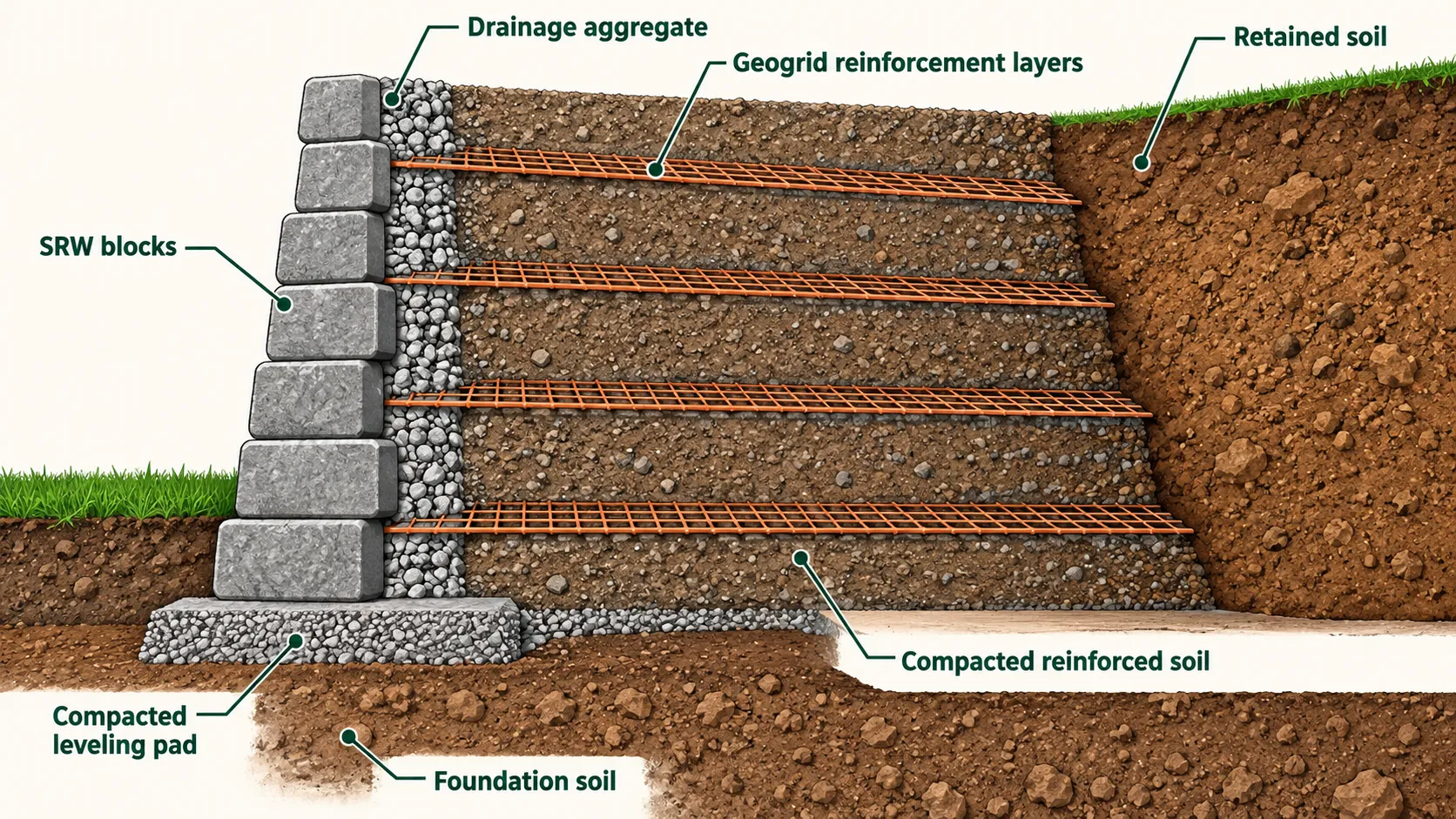
Illustrative diagram. Actual construction details depend on site conditions and project design.
Why does the base of a retaining wall matter so much?
The base supports the wall and helps distribute its weight onto the ground.
If the foundation soil is soft, saturated, poorly compacted, or uneven, the wall may settle or move. Excavation, suitable base materials, compaction, and drainage are important parts of many retaining wall installations.
A finished wall can look attractive while hiding problems beneath the surface, which is why the construction process matters.
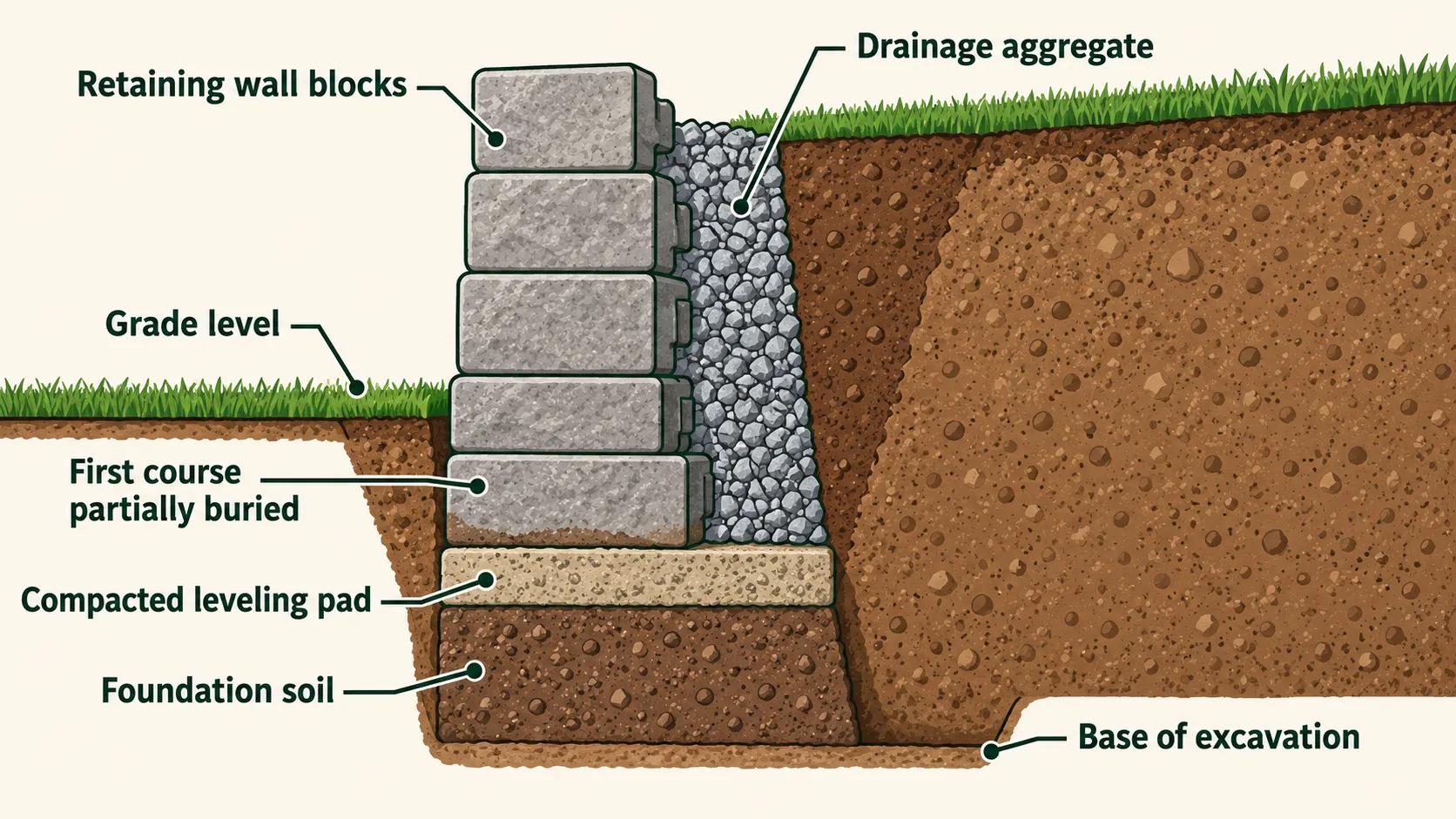
Illustrative diagram. Actual construction details depend on site conditions and project design.
Are poured concrete retaining walls better than block retaining walls?
Neither system is automatically better for every project.
Poured concrete retaining walls can be designed for a range of structural applications and may be appropriate where strength, geometry, or site conditions favor reinforced concrete construction.
Segmental concrete block systems offer different finishes and configurations and can be well suited to many residential retaining wall projects when properly designed and installed.
The appropriate choice depends on wall height, soil conditions, loading, drainage, available space, appearance, and budget.
For taller or more heavily loaded walls, the structural design matters far more than whether the visible surface is poured concrete or manufactured block.
Designing a More Usable Outdoor Space
Discover how retaining walls can improve sloped yards, create level areas, and work with other outdoor features.
Can a retaining wall make my backyard bigger?
A retaining wall cannot increase your property boundaries, but it may make more of your existing land usable.
By managing elevation changes, a wall or series of terraces can create flatter areas for lawns, gardens, patios, or outdoor activities.
The amount of usable space depends on the slope, wall placement, property boundaries, and surrounding conditions.
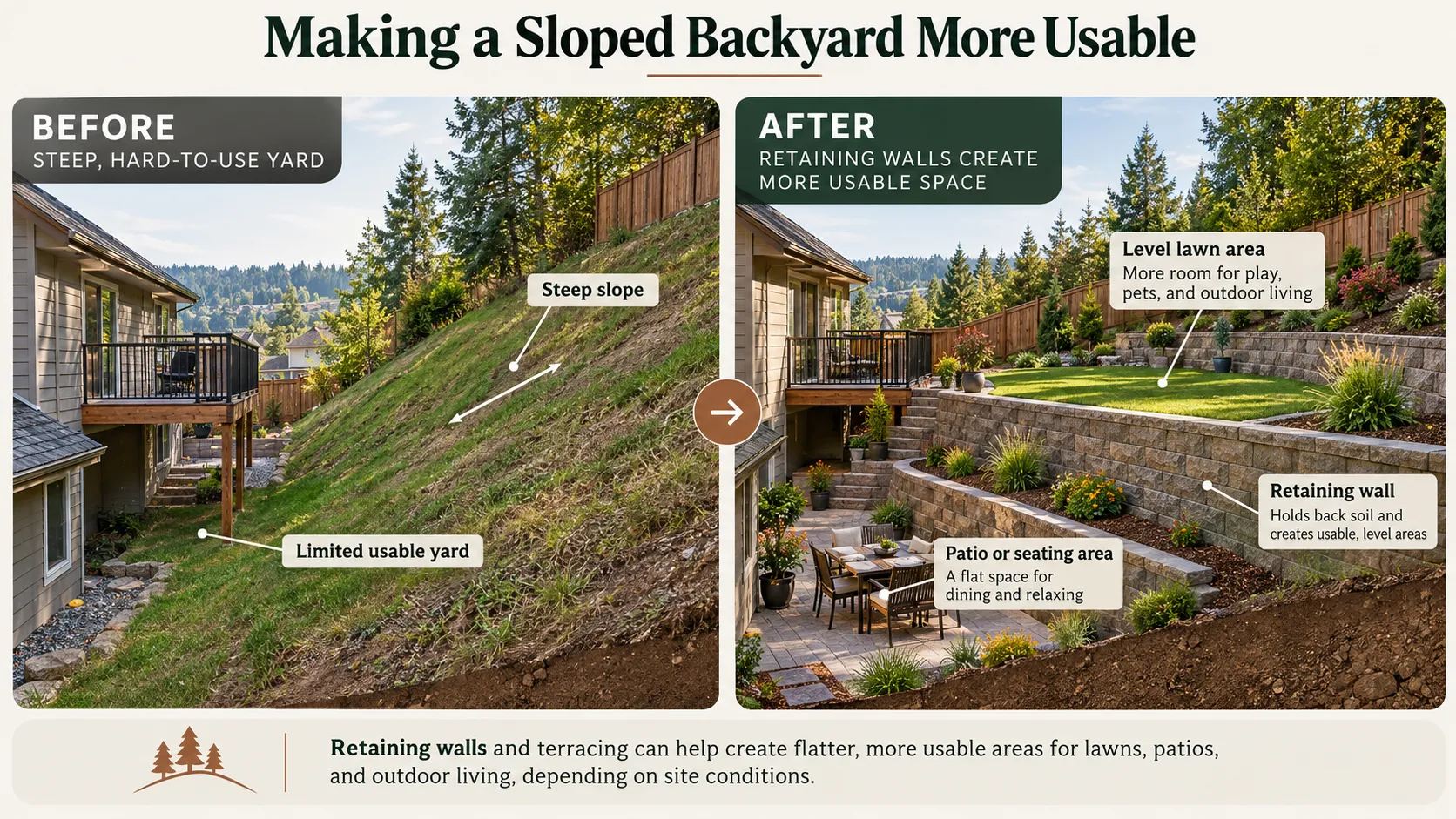
Conceptual illustration. Actual results depend on site conditions and project design.
Is one tall retaining wall better than several shorter walls?
It depends on the site and your goals.
A single taller wall may preserve more horizontal space in some layouts. Multiple terraces can create planting areas and distribute elevation changes across the property.
However, closely spaced walls can affect one another structurally. Two short walls are not automatically simpler or exempt from engineering or permit requirements.
The layout should be evaluated as a complete system.
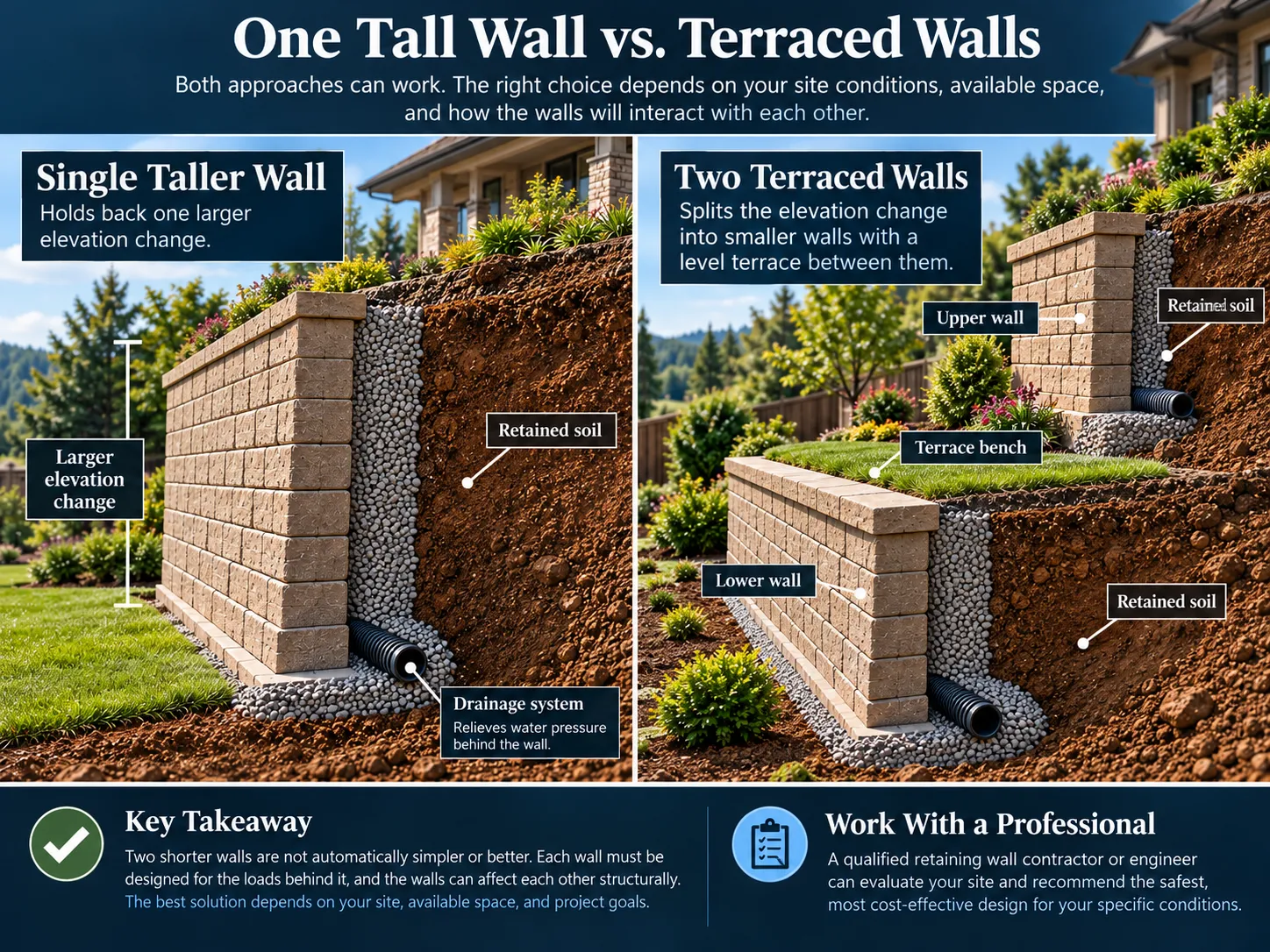
Illustrative diagram. Actual construction details depend on site conditions and project design.
Can I build a patio, driveway, or fence above a retaining wall?
Possibly, but additional loads can significantly change the wall's design requirements.
Driveways, vehicles, patios, buildings, fences, and slopes above a wall can create additional pressure known as surcharge loading.
These conditions should be considered before the wall is designed or modified. Do not assume an existing wall can support a new improvement simply because it appears stable.
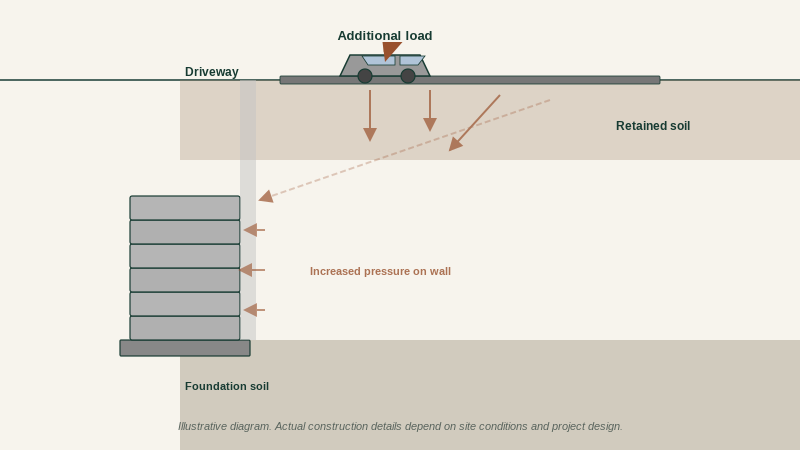
Illustrative diagram. Actual construction details depend on site conditions and project design.
Can retaining walls be combined with landscaping and outdoor living projects?
Yes. Retaining walls can work with patios, steps, walkways, planting beds, lawns, and other outdoor improvements.
Planning these features together can help coordinate elevations, access, drainage, and the overall appearance of the property.
If you're planning several improvements, discuss the complete project before construction begins so that one part of the work does not interfere with another.
Permits, Engineering & Property Considerations
Learn why local jurisdiction, wall height, nearby structures, and property boundaries can affect your project.
Do I need a permit for a retaining wall in Cartersville, GA?
The City of Cartersville publishes a retaining wall information sheet stating that walls over four feet measured from the bottom of the footing require a permit.
Its retaining wall application also identifies site plans, engineering documentation, and approval requirements for applicable projects.
Because a wall's location, height, and other site conditions can affect the process, confirm current requirements directly with the City of Cartersville Building Department before beginning construction.
Official resources:
Do I need a retaining wall permit in unincorporated Bartow County?
Bartow County Code Section 18-131 requires a building permit for retaining walls exceeding three feet in exposed wall height, or exceeding two feet when supporting a surcharge.
For a permit application, the ordinance calls for a site plan and construction details with structural calculations signed and stamped by a professional engineer.
The ordinance also addresses tiered retaining walls, which may need to be considered together when positioned close to one another.
These are county requirements for applicable unincorporated properties. Confirm current requirements with the county before construction.
Official ordinance: Bartow County Code of Ordinances, Section 18-131
When does a retaining wall need an engineer?
Engineering requirements depend on the jurisdiction, wall dimensions, loading conditions, and design.
Walls supporting driveways, structures, steep slopes, or significant additional loads may need particular attention. Even where engineering is not explicitly required by a permit threshold, complex site conditions can make professional engineering advisable.
Cartersville and Bartow County publish their own requirements for applicable projects.
Ask the permitting authority and the contractor how engineering will be handled before construction begins.
Official resources:
Can I build a retaining wall along my property line?
A retaining wall near a property line requires careful planning. The construction footprint may involve excavation, drainage, reinforcement, or access beyond the visible face of the wall.
Easements, subdivision restrictions, and local requirements may also affect placement.
Confirm the property boundary before planning construction. If the boundary is uncertain, a survey may be appropriate. Do not assume a neighboring property can be used for excavation, reinforcement, or drainage without permission or other required authorization.
Who is responsible for a retaining wall between neighboring properties?
Responsibility depends on factors such as property ownership, the wall's location, applicable agreements, easements, and local law.
The fact that a wall benefits one property or faces another does not automatically establish who must pay for repairs.
Review available surveys and property documents. If there is a disagreement over ownership, access, drainage, or repair responsibility, consult a qualified local professional before authorizing work.
Can a retaining wall be built near a septic tank or drain field?
A retaining wall near a septic system requires careful planning because excavation, heavy equipment, changing soil grades, and additional loads can interfere with buried components or affect how the system functions.
The septic tank, drain field, and any replacement area should be identified before deciding where to place a wall.
Do not assume that a wall can be built over or immediately beside a drain field simply because the area appears unused.
Ask the local environmental health authority to review applicable setbacks and restrictions. The appropriate location depends on the septic system, site conditions, and current requirements.
Official resource: Georgia Department of Public Health: Onsite Sewage
Lakes, Waterways & Shoreline Considerations
Properties near Lake Allatoona, creeks, rivers, and flood-prone areas can involve additional planning considerations. Learn what to investigate before changing a shoreline, disturbing soil, or building a retaining wall near water.
Can I build a retaining wall along Lake Allatoona?
Possibly, but construction near Lake Allatoona requires special attention to property boundaries, shoreline zoning, and the type of work proposed.
The U.S. Army Corps of Engineers manages public lands and shoreline activities around Allatoona Lake. Its shoreline management program allows certain activities in designated limited-development areas, subject to applicable approvals.
The Corps requires plans to be submitted and approved before shoreline-protection work begins in eligible areas. Owning property beside the lake does not automatically mean you can build on Corps-managed land.
Before planning a lakeside retaining wall, determine where your property ends, whether the proposed work affects Corps-managed land, and which approvals may apply.
For shoreline questions, contact the Allatoona Lake Project Management Office at 678-721-6700.
Official resources:
What's the difference between shoreline stabilization and a retaining wall?
A retaining wall is a structure designed to hold back soil across a change in elevation. Shoreline stabilization focuses on reducing erosion caused by water movement, waves, fluctuating water levels, and runoff.
Depending on the conditions, shoreline stabilization may involve appropriately designed stone protection, vegetation, engineered structures, or a combination of measures.
A conventional landscape retaining wall is not automatically suitable for use beside a lake or creek.
The appropriate solution depends on the shoreline conditions, soil, water movement, property boundaries, and applicable regulations.
For Lake Allatoona, review the Corps' shoreline protection guidance before selecting a construction method.
Official resource: Allatoona Lake Shoreline Protection
Can I replace an existing retaining wall near a lake or creek?
Possibly, but an existing wall does not automatically establish that replacement can proceed without approval.
Work near a shoreline or stream may involve land-disturbance requirements, shoreline restrictions, floodplain rules, or other environmental considerations.
A replacement project can also change the wall's location, dimensions, drainage, or effect on the surrounding soil and water.
Before removing or rebuilding the wall, determine who controls the affected land and whether the work requires local, state, or federal authorization.
For Lake Allatoona, contact the U.S. Army Corps of Engineers. For streams and creeks, check applicable local requirements and Georgia Environmental Protection Division guidance.
Official resources:
Do I need approval to build a retaining wall in a floodplain?
Construction in a regulated floodplain may require a floodplain development permit and additional review, even when the proposed wall is relatively small.
Excavation, grading, placing fill, changing drainage, or constructing a retaining wall can affect how floodwater moves across a property.
The applicable requirements depend on the property's flood designation, local ordinances, and the nature of the proposed work.
Before construction, contact the local floodplain administrator and describe the project. If a creek, stream, or other regulated waterway is involved, additional approvals may be necessary.
Do not assume that a regular retaining wall permit is the only authorization required.
Official resource: Georgia Environmental Protection Division: Floodplain Management
How can I find out whether my property is in a floodplain?
Start with Georgia's official flood-risk mapping resources or FEMA's Flood Map Service Center.
You can search by property address to review available flood hazard information.
Pay attention to the property's location relative to mapped flood zones, nearby streams, and low-lying areas.
Flood maps are useful screening tools, but they may not identify every drainage or flooding problem. A property outside a mapped high-risk floodplain can still experience runoff or flooding.
If your project is near a mapped floodplain or waterway, contact the local floodplain administrator before planning excavation, grading, or construction.
Official resources:
Planning Your Retaining Wall Project
Know what to prepare, what happens during construction, and how to take the next step.
How long does it take to build a retaining wall?
A small, accessible wall may take only a few working days to construct after the site is ready. Larger projects can take considerably longer.
Demolition, excavation, difficult equipment access, drainage improvements, reinforcement, engineering, permitting, weather, and material availability can all affect the schedule.
Ask for a project-specific timeline once the proposed work has been defined.
What should I do before requesting a retaining wall estimate?
Start by identifying the problem you want to solve or the improvement you want to make.
If possible, note the approximate wall length, visible height, location, and any drainage or erosion concerns. Photographs can help explain the situation, particularly if an existing wall is leaning or cracking.
You do not need to know the engineering details or choose materials before making an inquiry.
What should I know about underground utilities before building a retaining wall?
Retaining wall construction often requires excavation for the foundation, drainage, backfill, or reinforcement. Buried gas, electric, water, communications, and other utility lines may be present even when there are no visible signs above ground.
Before excavation, contact Georgia 811 to request utility marking. Georgia 811 currently instructs property owners and excavators to submit a locate request at least three business days before digging.
Remember that utility markings may not identify every privately owned line, such as certain irrigation, landscape lighting, or privately installed utility connections.
The contractor should account for utility locations before excavation begins.
Official resource: Georgia 811: The 811 Process
What happens after I submit a retaining wall inquiry?
Tell us about your property and what you're considering. Include the location, type of project, and any concerns about an existing wall, drainage, or erosion.
Your inquiry can be reviewed and, where appropriate, shared with an independent contractor serving your area who may contact you about the project.
A site visit or further assessment may be needed before a construction estimate can be prepared.
Choosing a Retaining Wall Contractor
Know what to ask, what to verify, and what to expect before hiring someone to build or repair a retaining wall.
What qualifications should I look for in a retaining wall contractor?
Look for experience with projects similar to yours in height, material, and site conditions. Ask how the wall will handle soil pressure, water, and any loads above it, and request a written scope describing the work, materials, drainage approach, and cleanup.
References, photos of comparable completed work, and a clear explanation of how unexpected site conditions will be handled all help you compare contractors on substance rather than price alone.
Be cautious of anyone who dismisses obvious structural or drainage concerns, pressures you to decide immediately, or requests full payment before work begins.
Does a retaining wall contractor need a Georgia state license?
Not always. Georgia recognizes specialty-contractor exemptions under O.C.G.A. § 43-41-17 for certain engineered retaining-wall, landscaping, masonry, grading, and sitework activities, so a state residential or general contractor license is not universally required for every service advertised on this site.
State licensing is separate from local building permits, engineering requirements, inspections, business registrations, and insurance. A contractor may be exempt from state licensure while still needing a local permit or engineered plans for a particular wall.
Ask any contractor you are considering about the licensing that applies to your specific project, and verify it independently. This website does not verify contractor licenses and does not claim that every participating contractor holds a state license.
Official resources:
What insurance should a retaining wall contractor carry?
Ask for proof of general liability insurance, and ask about workers’ compensation coverage if the contractor has employees. These types of insurance can provide important protection if property is damaged or someone is injured during construction, subject to the applicable policy's coverage and exclusions.
Also confirm who is responsible for permits, engineering, and inspections for your project. A contractor may handle some or all of these, but the property owner often remains responsible for making sure required approvals are in place.
This website does not verify contractor insurance. Request current certificates directly from any contractor you are considering and confirm that coverage applies to your type of project.
Should my retaining wall project be covered by a written contract?
Yes. A written agreement should describe the scope of work, materials, wall location and approximate dimensions, drainage approach, start and completion expectations, payment schedule, and what is excluded.
It should also identify who is responsible for permits, engineering, and site restoration, and explain how changes or unexpected conditions will be handled.
Any warranty that applies to your project should be written into the signed agreement with the contractor who performs the work. Read the contract carefully before signing, and keep a copy for your records.
Still Have Questions About Your Property?
Every property is different. Whether you're concerned about a failing retaining wall, dealing with drainage or erosion, or planning something new, start by telling us what you're seeing.